Tools
Choosing a First Hand Saw: A Beginner's Comparison of Tenon, Panel and Japanese Saws
A hand saw is one of the first tools that makes woodworking feel real. It also exposes every bad habit: rushing, forcing, sawing without a line. The good news is that saws are not complicated. Most beginner confusion comes down to three families: the tenon saw, the panel saw and the Japanese saw. Each cuts wood well, but they ask different things of you and suit different jobs.
The three saws in plain terms
A tenon saw is a backsaw. The rigid spine along the top keeps the blade straight, which makes it accurate for joinery. Its teeth are usually fine, so it cuts slowly but cleanly. It is the saw you reach for when cutting tenon shoulders, lap joints, mitres and small accurate crosscuts.
A panel saw is the traditional long hand saw. It has a wider blade, a comfortable handle and coarser teeth. It is designed for breaking down boards, trimming plywood or MDF, and cutting softwood to length. It removes material quickly, but it is not the tool for delicate joinery.
A Japanese saw cuts on the pull stroke. The blade is thin and often needs less force. Common types include the ryoba, which has crosscut teeth on one edge and rip teeth on the other, the dozuki, a fine backsaw for joinery, and the kataba, a single-edged saw for general work. Many Japanese saws have replaceable blades, which suits beginners who do not want to learn sharpening straight away.
Tooth count: the number that changes everything
Tooth count is measured in teeth per inch, usually shortened to TPI. The principle is simple: more teeth mean smaller teeth. A fine saw cuts slowly, leaves a smoother surface and is easier to control. A coarse saw cuts quickly, leaves a rougher edge and can wander if you push it.
Tooth shape matters too. Rip teeth are shaped like small chisels and cut along the grain. Crosscut teeth are shaped like knives and score across the grain. Some saws, especially Japanese ryobas, give you both edges so you can choose the right one for the job.
- Coarse (roughly 7–9 TPI): panel saws and other large saws for fast crosscuts and rough sizing.
- Medium (roughly 10–14 TPI): tenon saws and general bench saws for accurate crosscuts and joinery shoulders.
- Fine (roughly 15 TPI and above): dozuki and small backsaws for dovetails, tenon cheeks, trimming and delicate work.
If you remember one thing, remember this: choose the finest saw that will still do the job in a reasonable time. Too coarse and you will tear the wood. Too fine and you will saw forever.
Push versus pull: two different conversations
Western saws cut on the push stroke. You apply power as you push away from your body. The blade is thicker to resist buckling, and the handle sits at the back of the saw. This feels natural to most beginners because you can lean into the cut.
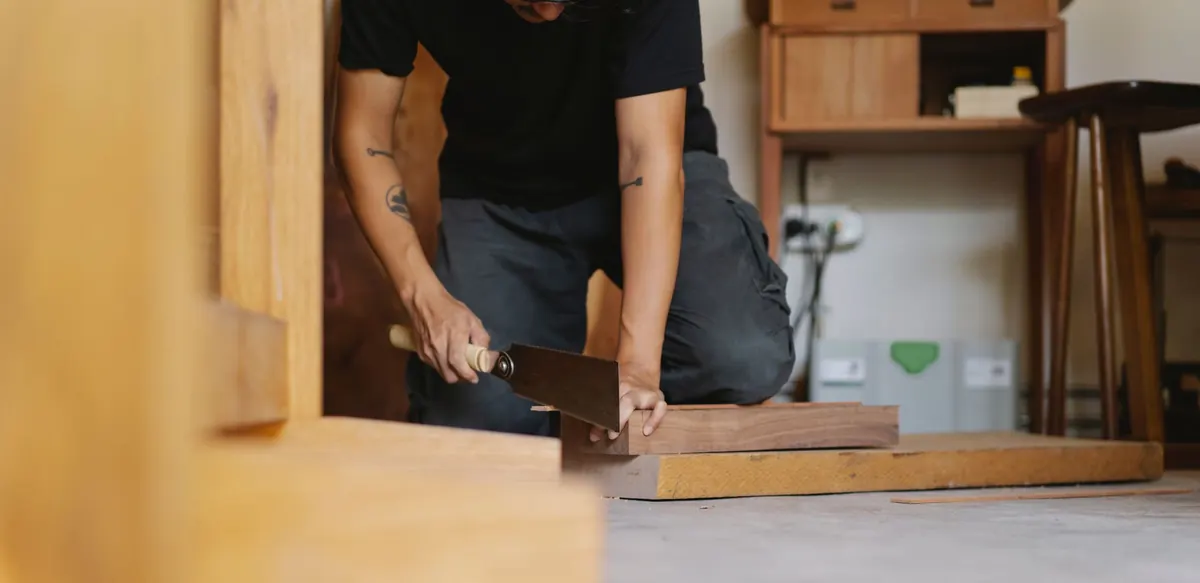
Japanese saws cut on the pull stroke. The handle is the part you pull, and the teeth face back towards your body. The blade can be thinner because pulling keeps it taut rather than bending it. The result is a narrow kerf, less waste and often a very clean cut. The trade-off is technique. You must let the teeth do the work and avoid bearing down. A light, steady pull is more effective than a heavy one.
Neither style is better. A push saw is reassuring for heavy cutting and long boards. A pull saw is excellent for fine joinery and controlled trimming. If you already own a Western saw, adding a small Japanese saw can teach you a lot about sensitivity and control.
Which saw for which beginner job
Tenon saw
Use a tenon saw when accuracy matters more than speed. It excels at cutting tenons, shoulders, lap joints and small mitres. Pair it with a bench hook or a vice, mark your line with a knife, and start the cut on the waste side of the line. The stiff back keeps the blade true, so you can concentrate on keeping the saw level.
Panel saw
Use a panel saw for board sizing. It is the right choice for cutting a shelf to length, trimming a plywood panel or reducing a length of softwood. Support the work on saw horses, keep the offcut supported so the blade does not pinch, and let the saw travel its full length. Long, relaxed strokes are more accurate than short, frantic ones.
Japanese saw
Use a Japanese saw for joinery, fine crosscuts and trimming. A ryoba is a versatile first pull saw because it offers rip and crosscut teeth. A dozuki is better for dovetails and tenon cheeks. These saws are not ideal for abrasive sheet goods such as MDF if you want to keep the blade sharp, and most impulse-hardened blades cannot be resharpened. Treat them as precision tools, not rough-and-ready site saws.
What to look for in a first saw
Buy fewer saws, but buy sharp ones. A blunt saw is more dangerous and more frustrating than a sharp one because you have to force it. Check the handle fits your hand, the blade is straight and the teeth are clean and evenly set. If you choose a Western saw, ask whether it can be sharpened; a good tenon saw can last for decades with occasional attention.
Store saws somewhere dry. A light wipe with oil on the blade helps prevent rust, and a simple blade guard protects the teeth. If a saw starts wandering, stop and check your technique before blaming the tool. Often the problem is too much downward pressure or starting the cut without a clear line.
A practical way to start
If you mainly want to cut joints, start with a tenon saw in the 10–12 TPI range and add a small Japanese dozuki later. If you mainly break down boards, start with a panel saw. If you want one saw that can handle both fine joinery and general cutting, a ryoba is a sensible compromise. Buy one, learn how it behaves on scrap, and practise starting a cut exactly on the line. Good sawing is not about strength. It is about rhythm, sharp teeth and letting the
Photo: Ono Kosuki / Pexels